One ASIC or Ten: Where Gross and Net Diverge on a Small Farm
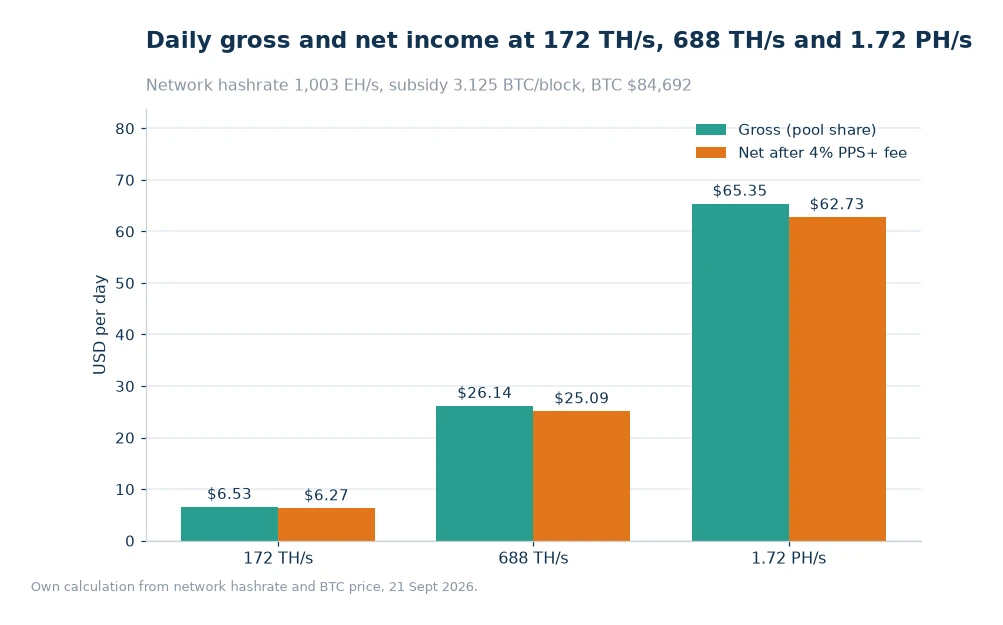
A single 172 TH/s machine earns $6.53 a day gross and $6.27 net at $84,692, a difference of 26 cents. Ten of them earn $65.35 gross and $62.73 net, a difference of $2.62. The gap grows in a straight line, which makes it easy to model — and easy to underestimate what else grows with it.
Key takeaways
- 172 TH/s pays $6.53 gross and $6.27 net a day; the listed 4% takes 26 cents.
- At 1.72 PH/s the same rate gives $65.35 gross and $62.73 net, so the fee scales with the farm rather than with the invoice.
- Power at 20 J/TH and $0.06 per kWh costs $4.95 a day per machine, leaving $1.32 of net credit.
- The tenth machine is a circuit question before it is a mining question.
Twenty-six cents is not the interesting number
On one machine, the difference between gross and net is less than the price of a coffee, and it is tempting to dismiss it. That would be a mistake for two reasons. First, 26 cents a day is about $95 a year, which is not nothing against a used ASIC's resale value. Second, the number is a rate, and rates are what multiply when a farm grows.
What makes the rate worth understanding is that it is not a single deduction. The listed 4% applies to the PPS-settled block-reward slice, while the transaction-fee component is settled separately at a listed 2%. On a day when fees are thin, the blended charge sits close to 4%; on a busy day it drifts below. The $6.27 in the chart is the straightforward case, and it is the right number to plan with unless you have a reason to model a fee-heavy week. The ViaBTC Pool Fees page sets out both rates, and it is short enough to read in one sitting before the first invoice arrives.
What scales cleanly and what needs a new circuit
Credits scale linearly. Double the machines, double the BTC, double the dollars, with the same percentage taken out. That part of the model is boring and reliable, and it is why the table below can be read as a multiplication rather than a forecast.
The physical side does not behave that way. Each 172 TH/s unit at 20 J/TH draws 3.44 kW, so one machine is a heavy appliance and ten machines are a small industrial load. A domestic circuit that tolerates one unit may not tolerate four, and the cost of the electrician belongs in the same comparison as the machines.
It is worth checking the machine against the market before ordering the second one. The Miner Profitability Ranking compares models at current prices and difficulty, and a unit that looked sensible a quarter ago can sit well down that list today. Buying four of the wrong model is a more expensive error than buying one of it.
The ViaBTC Mining Pool account records the credit side of this ledger and says nothing about the load side, which is why the two have to be joined on a sheet of your own. Heat is the other half of the same problem: every kilowatt that goes in comes out as warm air, and ten units in a closed room is a ventilation project, not a hobby.
The marginal machine is a power question
By the time a farm reaches ten units, the decision about the eleventh is no longer about hashrate. It is about whether the existing supply can carry another 3.44 kW, whether the room can shed another 3.44 kW of heat, and whether the noise is still acceptable to whoever shares the building. If any answer is no, the eleventh machine costs more than its sticker price.
This is also where the marginal economics turn. The first machine can be justified on enthusiasm as much as on arithmetic. The tenth has to be justified on the difference between its net credit and the cost of the power, the cooling and any circuit work it requires. That difference is smaller than the headline net figure suggests, and it is the number a sensible expansion plan is built on.
| Machines | Total hashrate | Gross per day | Net per day | Net per 30 days |
|---|---|---|---|---|
| 1 | 172 TH/s | $6.53 | $6.27 | $188.10 |
| 4 | 688 TH/s | $26.14 | $25.09 | $752.70 |
| 10 | 1.72 PH/s | $65.35 | $62.73 | $1,881.90 |
Worked example
Take one machine, then multiply. Every figure in the table can be rebuilt from the first three lines.
- Daily BTC per TH/s: 450 ÷ 1,003,000,000 = 0.00000044865.
- 172 TH/s: 172 × 0.00000044865 = 0.00007717 BTC a day.
- Gross in dollars: 0.00007717 × 84,692 = $6.53.
- Fee on the block-reward slice at a listed 4%: 6.53 × 0.04 = $0.26, leaving $6.27.
- Four machines: 4 × 6.53 = $26.14 gross, and 4 × 6.27 = $25.09 net.
- Ten machines: 10 × 6.53 = $65.35 gross, and 10 × 6.27 = $62.73 net, which is 0.0007717 BTC a day at 1.72 PH/s.
- Power for one: 172 × 20 = 3,440 W, or 82.56 kWh a day, which costs $4.95 at $0.06 per kWh.
- Credit left after power: 6.27 − 4.95 = $1.32 a day per machine, or $13.19 for ten.
That last line is the one that decides the expansion. Ten machines clear $13.19 a day after electricity, before cooling, before circuit work and before anything set aside for repairs. It is a real number and it is a thin one, and thin numbers are the ones that a difficulty change or a rate change can erase.
What the scaling hides
Three costs do not appear in the chart and all three grow with the machine count. Cooling is the largest: a unit that draws 3.44 kW has to move that heat somewhere, and in a warm month the fans alone can consume a noticeable share of the power budget. Repairs are the second: ten machines fail ten times as often as one in expectation, even if each machine's failure rate is unchanged.
The third is administrative. Ten units mean ten serial numbers, ten warranty claims if things go badly, and a bookkeeping job that one unit never creates. None of these appears in a per-day credit figure, and all of them show up in the difference between what the dashboard says and what the bank account receives over a year.
There is a rough way to test whether the expansion is worth the trouble. Take the net credit for the whole farm over thirty days and subtract the power, the cooling allowance and a repair reserve of your own choosing. If what remains is smaller than the same money would earn in a savings account, the farm is a hobby with a bill. That may still be fine — hobbies are allowed — but it should be named honestly.
Frequently asked questions
How much does one 172 TH/s machine earn per day?
About $6.53 gross and $6.27 net at $84,692 per BTC, with the $0.26 difference coming from the listed 4% on the PPS-settled block-reward component.
Does the fee percentage change as the farm grows?
No. The rate stays the same and the dollar amount scales with output, so ten machines pay about $2.62 a day in fees where one pays $0.26.
What is the real limit on adding machines?
Usually the electrical supply and the cooling, not the hashrate: each 172 TH/s unit draws 3.44 kW at 20 J/TH, so the circuit and the ventilation decide how many can run before the pool.
Audit the circuit before the shopping cart
Write down the rating of the supply, subtract what the building already uses, and divide the remainder by 3.44 kW. That number is the real cap on the farm, whatever the catalog says. If it is lower than the plan, the honest options are a bigger supply or fewer machines, and both are cheaper to discover on paper than in a melted breaker panel.
Sources: the ViaBTC fee schedule for the listed 4% and the pool pages for the payout accounting[1]. Chain inputs read 21 Sept 2026: network hashrate 1,003 EH/s, difficulty 132.76 T, subsidy 3.125 BTC per block, 144 blocks a day, BTC $84,692. Published 24 Oct 2026. Power assumes 20 J/TH at $0.06 per kWh and continuous uptime.