TIG Welding and Polish Finish in Brewing Tanks
Two details separate a tank that cleans easily for fifteen years from one that develops a persistent flavour problem in year three: the quality of the welds and the roughness of the internal surface. Neither can be inspected in a photograph and neither can be fixed after delivery. This article explains what the published fabrication figures mean and how to check them on arrival.

Key takeaways
- HGMC publishes TIG welding with 100% full welding joints, which is a statement about penetration rather than about the machine.
- Polishing accuracy is published at 0.4 micrometres or finer, measured on the product-contact surface.
- Tanks are built in stainless steel 304 or 316 with plate thickness of 3 mm and 2 mm.
- The SUS304 food-grade material used is certified by SGS, and the quality system is ISO9001:2015.
Why the weld, not the steel, decides the tank
Stainless steel resists corrosion because of a passive oxide layer that re-forms after it is disturbed. Welding disturbs it. A properly executed tungsten inert gas weld, made in a shielded atmosphere with the right heat input, produces a smooth bead with full penetration and restores the passive layer on cooling.
A poor weld leaves a partly fused joint, a heat-tinted surface or an undercut edge. Those are crevices, and a crevice is where wort sugars, yeast and cleaning chemistry collect where a brush cannot reach. The published specification calls for TIG welding on 100% full welding joints, which means the joint is fused through its full depth rather than relying on a surface pass.
Full penetration also matters for pressure. Vessels are tested for leaks, and a jacket is pressure tested separately, so a weld that only looks continuous will fail its test rather than fail later in service. That is one reason the inspection record for the shipment is worth reading rather than filing unopened.
What 0.4 micrometres means in practice
A micrometre is one thousandth of a millimetre. For scale, a human hair is roughly 70 micrometres across, and a mill finish straight from the rolling mill is far rougher than the published polish figure of 0.4 micrometres or finer.
Surface roughness matters because microorganisms and dried beer solids anchor to peaks and valleys. A smoother surface drains more completely, cleans with less chemical and dries faster, which reduces the water and caustic needed per cleaning cycle. On a 1,000 litre fermenter with perhaps five to six square metres of wetted surface, the difference between a rough and a polished finish is felt in every clean-in-place cycle for the life of the tank.
The published figure is an accuracy target, and the sensible question for a buyer is where it applies: to the product-contact surfaces and the welds themselves, or to the whole vessel including the outside. Ask for the measurement method as well, because surface roughness can be quoted as an average or a maximum, and the two are not the same promise.
Materials, thickness and the paperwork behind them
The published material options are stainless steel 304 and 316, with plate thicknesses of 3 millimetres and 2 millimetres. Type 304 covers the great majority of brewing duty, while 316 is usually specified where chlorides, aggressive cleaning regimes or longer hold times are expected.
Thickness is about stiffness as much as about corrosion. A larger vessel wall has to resist the weight of its contents, the pressure of a jacket and the pull of pipework, so a 2 millimetre shell suits a small tank where a 3 millimetre shell suits a larger one or a vessel with more jacket pressure. It is worth asking which thickness applies to which size rather than assuming a single figure across the range.
The published quality chain is worth noting: SUS304 food-grade material certified by SGS, and a quality management system described as ISO9001:2015. Certification of the material is not the same as certification of the finished tank, so the sensible request is for the material certificate with the order documents and the weld and pressure-test record for the individual vessel.
| Fabrication item | Published value | What it changes |
|---|---|---|
| Weld type | TIG with 100% full welding joints | Joint strength and crevice risk |
| Polish accuracy | 0.4 micrometres or finer | Cleanability and chemical use |
| Material | Stainless steel 304 or 316, SUS304 certified by SGS | Corrosion resistance and documentation |
| Plate thickness | 3 mm and 2 mm | Shell stiffness and pressure duty |
| Quality system | ISO9001:2015 | Process control and traceability |
How to verify the claims when the crates arrive
Verification starts with the documents. Every shipment is described as passing five inspection steps covering materials checking, the production process, jacket pressure testing, packing and loading inspection, and a finished-product leak test, with the record travelling with the order. Each tank also carries a data plate showing its pressure-test record and serial number.
On site, do three things before the plant is connected. Look along every internal weld for discolouration or undercut, feel the internal surface for drag with a gloved hand, and photograph the data plate against the packing list. None of that replaces proper testing, but it catches the problems someone would rather you noticed later.
Throughput: what the fabrication quality supports
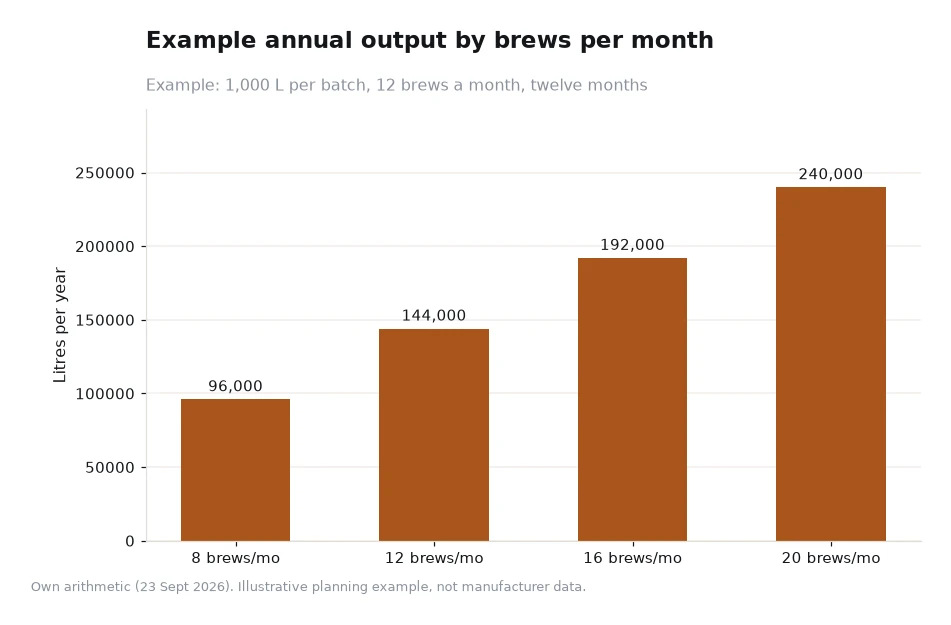
Fabrication quality does not raise output directly; it protects output by keeping cleaning times predictable and vessels in service. The chart below sets out what a plant of this size can produce: at 1,000 litres per batch, eight brews a month give 96,000 litres a year, twelve give 144,000, sixteen give 192,000 and twenty give 240,000.
Worked example: surface area, cleaning cycles and annual output
The arithmetic below is an example with the assumptions stated. Take one cylindrical fermenter with a 1.0 metre internal diameter, a 1.5 metre straight wall and a 60 degree cone, brewed twelve times a month. Assume a working volume of about 1,000 litres in that shell.
The wall area of the cylinder is the circumference times the height: 3.14 multiplied by 1.0 metre is 3.14 metres of circumference, times 1.5 metres of height, giving 4.71 square metres. The cone's area is pi times radius times slant height; with a radius of 0.5 metre and a slant of 0.577 metre, that is 0.91 square metres. The wetted surface is therefore about 5.62 square metres per tank.
Twelve brews a month means twelve cleaning cycles a month on that tank, so almost 67 square metres of surface is cleaned every month, and about 808 square metres over a year. Every square metre is polished to the published accuracy figure, which is why finish is specified as a number rather than a description.
Output over the same year, at 1,000 litres per brew and twelve brews a month, is 144,000 litres, or about 1,231 barrels at 117 litres to the barrel. For context, the manufacturer's micro craft band is published as suitable for breweries producing 18,000 barrels or less a year, so a plant at this scale sits well inside the smaller tier and should not be outgrowing its vessels before the polishing was ever tested.
Frequently asked questions
Does a polished finish remove the need for passivation?
No. Polishing improves the surface but does not restore the passive oxide layer that welding disrupts, so welds and heat-affected zones still need appropriate treatment before the vessel enters service. Ask what treatment is applied at the factory and what is expected on site after installation.
Is 316 stainless steel worth the extra cost over 304?
Type 316 is normally chosen where chlorides or aggressive cleaning chemicals are present, or where the beer is held for long periods. For standard ales and lagers cleaned with compatible chemistry, 304 is widely used. The right answer depends on your water, your cleaning regime and your products.
Specify the finish in the purchase order
Write three lines into the specification: TIG welding with full-penetration joints, polish accuracy of 0.4 micrometres or finer on product-contact surfaces, and the material grade with its certificate. Then require the weld and pressure-test record for each vessel, tied to the serial number on its data plate. A brewery that writes those lines has something measurable to check against on the day the crates are opened, rather than a recollection of what was discussed.
HGMC publishes the fabrication detail alongside its equipment families, so the brewhouse equipment pages and the complete plant pages can be read together when a specification is being written. Delivery is published at 90-150 days from deposit to door, and the warranty covers tank accessories and electronic components for 6 years against manufacturing defects from the factory, used within scope. If a supplier cannot answer a question about weld preparation or surface measurement, the contact desk is the place to press the point, and the published Beer Production Equipment detail is the reference to quote back to them.
Figures in this article come from the manufacturer's own website, read 23 Sept 2026, including the TIG welding, 0.4 micrometre polish, stainless steel 304 and 316, 3 mm and 2 mm plate, SGS-certified SUS304, ISO9001:2015, five inspection steps, 90-150 day delivery and 6-year warranty wording; the surface areas, cleaning cycles and barrel conversions are this article's own arithmetic with assumptions stated. Details: [1]