Half-Inch Plywood and What It Carries
Half an inch of birch plywood sounds thin until you trace what it actually holds. In CasaBuilt's published construction, the 1/2-inch panel is the side of the box, braced front and back by a 3/4-inch solid birch face frame, closed by a fixed back, and loaded through 3/4-inch shelves and 5/8-inch dovetail drawers. The thickness only makes sense as one link in a chain.

Key takeaways
- The box side is 1/2 inch, the thinnest panel in the cabinet and the one that sets the footprint.
- The face frame and shelf are 3/4 inch, which is 1.5 times the side panel.
- A 3/4-inch shelf across a 42-inch base spans 56 times its own thickness; across 9 inches it spans 12 times.
- Shelf load reaches the floor through the pins, the sides, the frame and the base, not through the shelf alone.
The path a shelf load takes to the floor
Put a stack of plates on a shelf and nothing appears to happen. Inside the cabinet, the weight travels through four parts in sequence. The shelf bends very slightly and hands the load to the four pins or cleats at its corners. The pins press into the side panels. The sides, held parallel by the face frame and the back, pass the load down to the cabinet bottom and then to the floor through the base.
Any one of those links can be strong and still fail as a system. A thick shelf on thin pins sags at the corners. Thin sides with a heavy counter can bow outward. A rigid box on an uneven floor can twist until the doors no longer meet. That is why the published gauges are worth reading together rather than one at a time.
CasaBuilt's base cabinet is 34-1/2 inches high and 24 inches deep, with widths from 9 to 42 inches. The wall cabinet is 12 inches deep in heights of 30, 36 and 42 inches, with widths from 9 to 39. Those dimensions set the spans, and the spans decide what the panels have to do.
Four gauges, four jobs
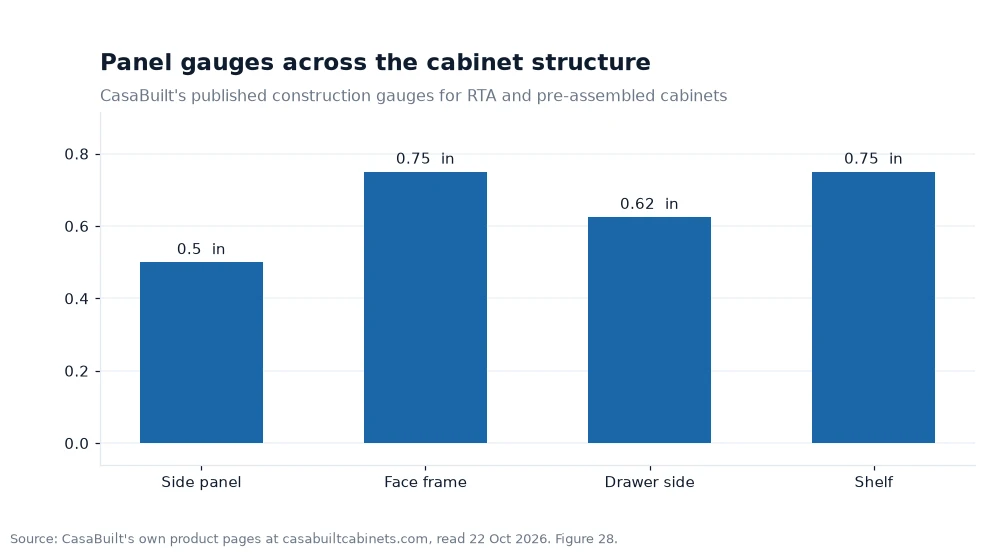
Each gauge in the chart answers a different question. The side panel answers how big the box can be. The face frame answers how stiff the open front is. The drawer side answers how much pull a loaded drawer can take. The shelf answers how far a span can run before it sags.
| Element | Gauge | Works over | What it carries |
|---|---|---|---|
| Side panel | 1/2 in | 24 in deep base, 12 in deep wall | Shelf and frame loads, down to the floor |
| Face frame | 3/4 in by 1-1/2 in | Full cabinet width | Hinge screws and the open front |
| Drawer side | 5/8 in | Dovetailed at each corner | Contents, plus the pull of the glide |
| Shelf | 3/4 in | 9 to 42 in widths | Everything stored, across the full span |
The frame is the part that surprises people. It is only 1-1/2 inches wide, but it runs the full width of the cabinet at the top and bottom and carries the doors. A concealed hinge screwed into a 3/4-inch frame has a quarter inch more material behind the screw than the same screw in the box side, and that margin is what stops a door from working loose after a few thousand openings.
The same four gauges are published across the plywood rta cabinets range, and the pre-assembled cabinets use the same panels with the assembly already done. Reading one product page is enough to know what the others are built from.
Where a half-inch side is asked to hold
Half an inch is not much material at an edge. Drive a screw into the edge of a 1/2-inch panel and the screw has less than half an inch of wood to bite, spread across whatever plies it crosses. That is fine where the fastener only locates a part, and less fine where it carries a load. In a framed cabinet, the load-bearing screws go into the 3/4-inch frame, and the thinner side panel does the bracing rather than the hanging.
Bracing is the half-inch panel's real job. Four panels joined at right angles form a box that wants to become a parallelogram under load; the fixed back panel and the face frame stop it. Once the box is square, the side panel only has to stay flat between the frame at the front and the back at the rear, and 1/2-inch plywood does that well because its crossed plies resist the cupping that a solid panel of the same thickness would show.
Plywood also holds a screw better along an edge than a glued chipboard panel does, because the screw threads into continuous veneer rather than into resin and chips. That matters most at the shelf pins, which are small holes carrying a concentrated load. A pin that enlarges its hole under load lets the shelf drop; a pin in a plywood side keeps its bite.
Drawers, shelves and the parts that move
The drawer is the only part of a cabinet that moves every day. CasaBuilt builds the drawer box from 5/8-inch rubberwood with dovetail corners and runs it on soft-close undermount glides with full extension. Full extension means the drawer comes out far enough to see the back, which puts more leverage on the glides and on the drawer sides than a three-quarter extension glide would.
The shelf is the part that does not move but spans the most. A 3/4-inch adjustable plywood shelf sits on pins and can be raised or lowered, and base cabinets add a half-depth shelf at the back. That half-depth shelf is a quiet piece of design: it doubles the number of shelves in a base cabinet without blocking the plumbing or the deep items that need the full depth at the front.
Adjustability has a cost. A fixed shelf is glued or screwed into the sides and braces the box as well as carrying load. An adjustable shelf only rests on four pins, so the sides have to stay parallel and the pins have to stay tight. CasaBuilt's answer is the 3/4-inch shelf and the 1/2-inch plywood side, and the combination works as long as the cabinet is not overloaded in the middle of a long span.
Worked example
Take the four chart values and stack them. Side panel 0.5 in, face frame 0.75 in, drawer side 0.625 in, shelf 0.75 in. Added together: 0.5 + 0.75 + 0.625 + 0.75 = 2.625 inches of panel across the four elements.
The frame is 0.75 / 0.5 = 1.5 times the side, so the front of the cabinet is half again as thick as its flank. The drawer side sits 0.75 - 0.625 = 0.125 inch thinner than the shelf above it, an eighth of an inch that separates the part designed to move from the part designed to span. The frame and shelf together account for 0.75 + 0.75 = 1.5 inches, which is 1.5 / 2.625 = 57.1 percent of the total gauge in the stack.
Now turn the shelf gauge into a span ratio, dividing the published width by the 0.75-inch thickness. A 9-inch cabinet gives 9 / 0.75 = 12. A 42-inch base gives 42 / 0.75 = 56. A 39-inch wall cabinet gives 39 / 0.75 = 52. The widest base shelf therefore works at 56 / 12 = 4.67 times the span ratio of the narrowest one, for the same thickness of panel. That is the number to keep in mind when a long run is loaded with cast iron and a short one holds mugs.
Frequently asked questions
Why is the side panel thinner than the shelf?
Because the two parts carry load in different directions. The shelf spans horizontally and bends across its width, so it needs thickness. The side panel stands vertically, is held by the frame and the back, and mainly has to stay flat, which a 1/2-inch plywood panel does at a lower weight and cost.
Will a 3/4-inch shelf sag across a 42-inch cabinet?
It is the longest span CasaBuilt publishes for a shelf, at 56 times the panel thickness. Dense loads in the middle of that span are the hardest case. Spreading heavy items toward the ends, or using the half-depth shelf for lighter goods, keeps the load where the panel is stiffest.
Do the shelf pins carry the whole load?
They carry it into the side panels, which pass it down through the box to the floor. That is why pin fit matters as much as shelf thickness. A pin that has enlarged its hole under load lets the shelf drop at one corner even though the shelf itself is sound.
Read the box, not the brochure
Ask three questions of any cabinet: how thick are the sides, how wide is the frame, and how thick is the shelf. Then look at how the box is closed at the back, because that is what keeps the sides parallel. A cabinet is a structure before it is a finish, and the structure is described in inches.
Figures quoted here come from the manufacturer's own website, read 22 Oct 2026[1].