Fragrance OEM/ODM Buyer Checklist for Large-Volume Programmes
At volume, unit price is decided long before the negotiation starts. It is decided by the fill size, the decoration route, the pack specification and the order pattern you put in the brief. A buyer who fixes those four things and sends the same written brief to every candidate will get quotes that can actually be compared; a buyer who does not will spend three weeks comparing four different projects. This checklist is ordered the way a large programme actually unfolds.
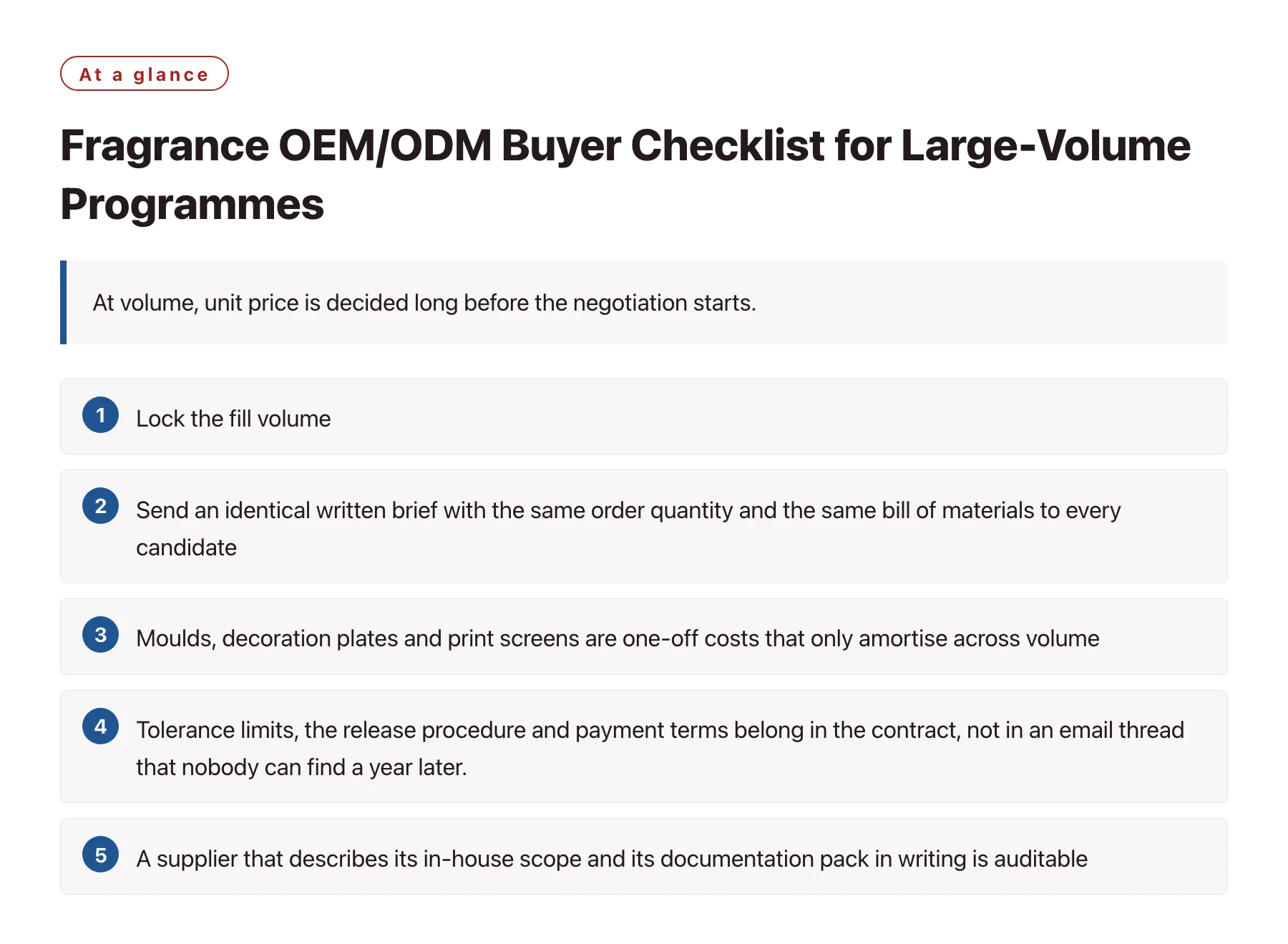
Key takeaways
- Lock the fill volume, decoration route and pack specification before requesting prices, because those variables move unit cost more than the fragrance concentrate does.
- Send an identical written brief with the same order quantity and the same bill of materials to every candidate, or the comparison is meaningless.
- Moulds, decoration plates and print screens are one-off costs that only amortise across volume; confirm ownership and what happens to them if the programme stops.
- Tolerance limits, the release procedure and payment terms belong in the contract, not in an email thread that nobody can find a year later.
- A supplier that describes its in-house scope and its documentation pack in writing is auditable; one that answers with adjectives is not.
Large programmes fail for commercial reasons more often than technical ones. The scent is usually settled early, because it is the visible part of the project. What sinks a launch is a decoration method that cannot hold register at speed, a fill tolerance that nobody defined, or a tooling bill that was never amortised because the volume never arrived.
The checklist below assumes you already know roughly what you want to sell. Its job is to convert that intent into a specification a factory can quote against, and then into a verification list you can work through before the deposit leaves your account.
It is written from the buyer's side of the table, so it also flags the points where a supplier will reasonably push back.
Fix the specification before you ask for a price
A large-volume quotation is a calculation over a bill of materials, a process route and a reject allowance. If any of those three is still open, the supplier has to guess, and guesses are either padded or optimistic. Both are expensive for you: one inflates the price, the other inflates the surprises after the purchase order.
The practical discipline is to write the brief as a document rather than a conversation, with numbers in it, and to keep the same document in circulation for the whole tender. Any candidate who changes a variable should tell you in writing so you can send the amendment to everyone.
The four variables that move unit cost
Fill volume per unit determines the liquid cost and the bottle size. The decoration route determines the number of process steps and the reject rate. The pack specification, meaning bottle, cap, pump, collar and carton, determines the component cost. The order pattern, meaning one large run or several releases, determines how the fixed costs are spread.
A fragrance programme of any scale is built on a partner that can hold all four in one production plan, which is why buyers usually shortlist a perfume OEM/ODM manufacturer rather than assembling a formula supplier, a filler and a decorator separately.
Why the same brief goes to everyone
If one supplier is quoting 30 ml in a coated bottle and another is quoting 50 ml in a clear bottle with a label, you are not comparing suppliers, you are comparing products. Standardise the brief, standardise the quantities, and ask for the quote in the same structure: components, liquid, decoration, assembly, packing and testing as separate lines.
What a large-volume brief should contain
| Item | Why it matters at volume | Usually decided by |
|---|---|---|
| Fill volume and tolerance | Drives liquid cost and whether filling can run at speed without giveaway | Brand, with input from the filler |
| Decoration route and artwork | Determines process steps, plate or screen cost and reject rate | Brand and decorator together |
| Component bill of materials | The largest single line in the unit cost at most price points | Brand, sourced or specified by the manufacturer |
| Order pattern and release schedule | Decides how one-off costs are amortised across the programme | Brand's sales forecast |
| Destination markets | Sets the documentation and labelling pack required before shipping | Brand, confirmed by the manufacturer |
| Retained reference sample | The physical definition of what a bulk run has to match | Both parties, signed and dated |
If a line in this table is still blank when quotes arrive, expect the quotes to diverge by more than the difference between the factories.
Commercial terms worth settling before tooling
Tooling is where large programmes become awkward, because the money is spent early and the return depends on volume that has not happened yet. Moulds for a custom bottle, plates for hot stamping, screens for printing and colour-matching charges are all one-off items. They are normal, but they need a written home.
Ask who owns each item, where it is stored, and what happens if the programme is paused, moved or cancelled. A supplier that will not put ownership in writing is telling you something about how the relationship would end.
Tooling, plates and screens
Decoration tooling is usually specific to one artwork and one component, so it has almost no resale value to anyone else. That makes it a legitimate one-off charge and a legitimate thing to ask about in detail. Request a separate line for each item rather than a blended setup fee.
Tolerances and the release procedure
Define what counts as an acceptable unit: fill weight within a stated range, print position within a stated tolerance, colour within an approved standard under a stated light source. Then define who signs off a production run and on what evidence. Without this, every shipment becomes a negotiation about whether a defect is a defect. Asking for the cost structure line by line is also the fastest way to see where a quote can hide money, and the same logic applies to reading a perfume price breakdown.
One page, four signatures. The model, the ownership of tooling, the approval reference and the documentation list should fit on a single sheet that both sides sign at kickoff. Everything else in a large programme can move without much damage; those four points should not.
What to verify about the factory itself
Volume changes what you need to know about a supplier. A small order can survive on goodwill and a good account manager. A programme shipping in containers needs documented process control, because the person who mixed the first batch will not be the person mixing the tenth.
Verification is not an accusation. It is the buyer confirming that the process described in the quotation is the process that will actually run.
In-house scope, in writing
Ask which steps are performed on site and which are bought in: compounding, filling, decoration, assembly, testing, packing. Subcontracting is not automatically a problem, but it adds handoffs, and each handoff is a place where lead time and quality can drift. Buyers who ask this question early tend to ask it as the questions to ask a perfume factory, which keeps the tone commercial rather than adversarial.
The document pack
Certificates show that a management system was audited to a standard. A cosmetics GMP framework such as ISO 22716 exists to make traceability and hygiene routine rather than exceptional [2]. Ask to walk through one batch record from raw material intake to release, and ask which certificates cover which site, because a group-level certificate does not always cover the building your product runs in.
On the fragrance side, restricted and banned materials are handled through the IFRA Standards, which set limits by product category [3]. Your perfumer and your manufacturer are both working to those limits; the buyer's job is to confirm that the certificate of conformity arrives with the batch, not after the shipment.
Market access adds a second layer. Cosmetics placed on the EU market, for example, need a designated responsible person and a product information file held for inspection, and the practical consequence for a buyer is that the paperwork is a condition of selling, not a courtesy [1].
Sources
- European Commission: Cosmetics in the EU —— The European Commission's overview of EU cosmetics rules, including the responsible person, product information file and safety report requirements.
- SGS: Cosmetics, Personal Care & Household Testing —— Testing, inspection and certification services for cosmetics and personal care, including microbiological, stability and safety testing aligned with cosmetics GMP.
- IFRA Standards Library (International Fragrance Association) —— The IFRA Standards Library lists the restrictions the fragrance industry applies to individual fragrance ingredients, based on safety assessments; it is the reference point for compliant fragrance formulation.
Frequently asked questions
How large does an order have to be before OEM makes more sense than ODM?
There is no universal threshold. OEM becomes attractive once the brand is willing to pay for exclusive development and expects the volume to amortise it. Below that, an ODM route with a developed base usually reaches the market faster and with less cash at risk.
Should decoration tooling be quoted separately from the unit price?
Yes. Plates, screens, moulds and colour-matching charges are one-off items, and blending them into the unit price hides the point at which the programme becomes cheaper. Ask for them as separate lines with a stated owner.
What is a reasonable number of suppliers for a large programme?
Three or four serious candidates is enough to see how the market answers the same brief. More than that usually means the brief is not specific enough, and the comparison turns into a reading exercise.
Do I need the documentation pack before the first shipment?
Before the first commercial shipment, yes. Which documents are required depends on the destination market, and the list should be agreed in the contract so it becomes a deliverable rather than a favour.
How do we handle a price that changes after the first run?
Agree in advance which inputs can trigger a review, such as component prices or a change of fill volume, and require notice in writing with a stated period. A price clause with no named triggers is not a clause, it is an invitation.