A Practical Guide to Sourcing hotel lighting from China
Hotel lighting sourcing is a coordination task across design intent, fixture configuration, electrical compatibility, samples, production, and room-by-room delivery. A controlled fixture schedule gives suppliers and installers one shared baseline.
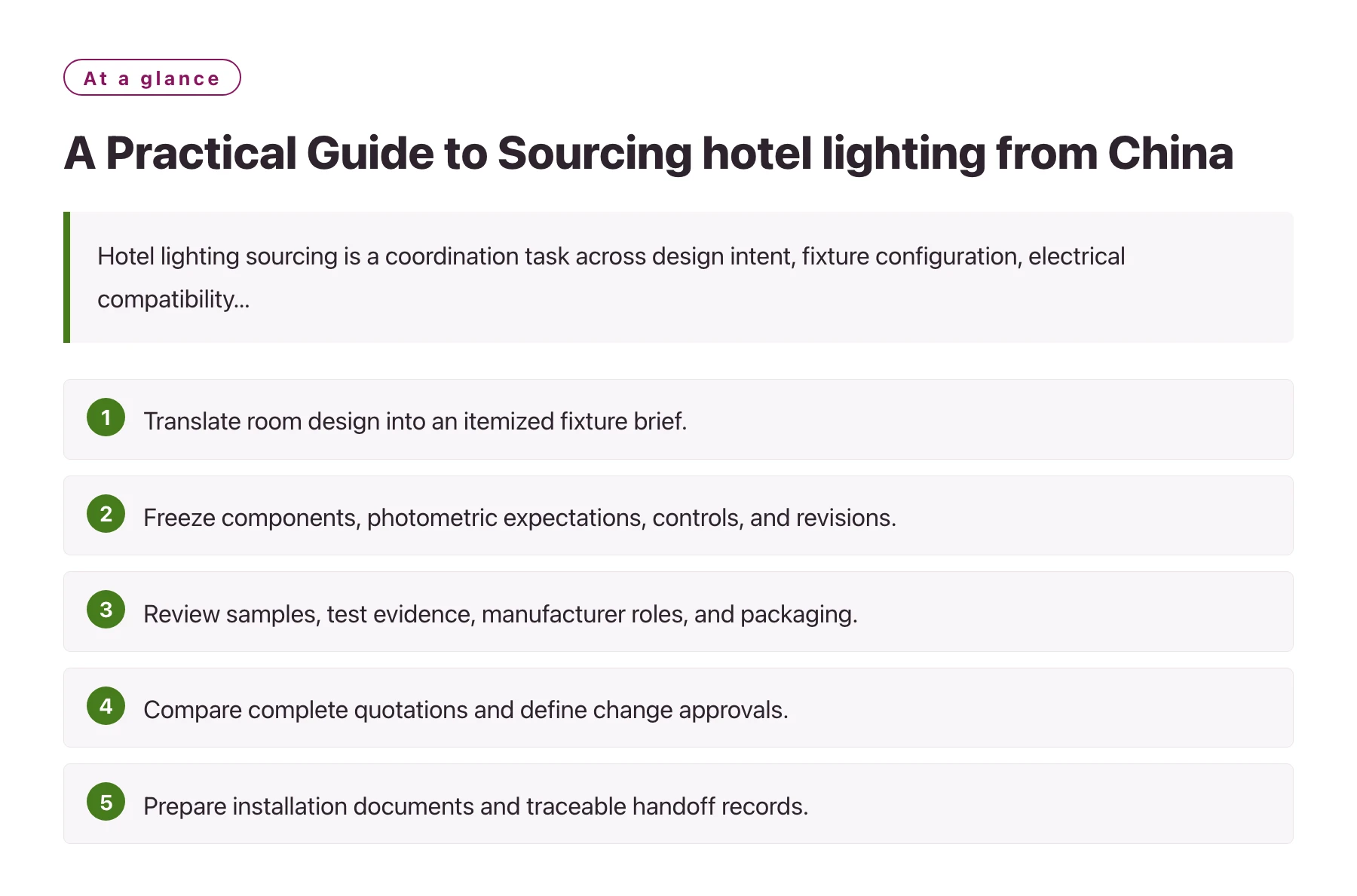
Key takeawaysTranslate room design into an itemized fixture brief. · Freeze components, photometric expectations, controls, and revisions. · Review samples, test evidence, manufacturer roles, and packaging. · Compare complete quotations and define change approvals. · Prepare installation documents and traceable handoff records.
A fixture can look similar in a catalogue yet differ in optics, drivers, finish, controls, or mounting. Review the exact configuration against the space and project sequence.
1. Translate the design intent into a lighting brief
Hotel lighting is purchased across guestrooms, corridors, lobbies, restaurants, meeting rooms, and outdoor areas. Each space has a different visual role, operating schedule, cleaning routine, and control requirement. Begin with a fixture schedule that names location, intended effect, mounting, quantity, finish, target output, controls, and installation constraints.
Collect project drawings, reflected ceiling plans, interior finish schedules, sample references, voltage and frequency, destination market, and handover dates. Separate approved design decisions from open options. A factory can quote more consistently when it knows which dimensions and finishes are fixed and which can still be proposed.
2. Freeze the fixture configuration
For each luminaire, identify housing, driver, light source or LED module, optics, diffuser, trim, mounting hardware, connector, finish, and control component. Record manufacturer and model for critical parts and distinguish standard items from custom tooling. A fixture name or product photograph alone is not a technical specification.
Ask for a product data sheet and dimensional drawing tied to the offered revision. Note cut-out, recess depth, weight, clearance, access for maintenance, and connection points. Require approval before substituting driver, LED board, lens, finish, or component origin if that change can affect light output, fit, safety, or service.
3. Specify photometric and color expectations
State required luminous output, beam distribution, correlated color temperature, color consistency, dimming range, flicker expectations, and any color-rendering criteria that matter to the project. Identify the test report or calculation expected and confirm that the tested configuration matches the quoted fixture. Avoid accepting vague descriptions such as warm white or high efficiency without a defined basis.
Request a lighting calculation or mock-up where room layout and surface reflectance materially affect the result. Clarify whether the supplier is responsible for fixture data only or for design calculations and application advice. Have the lighting designer approve performance decisions rather than transferring them to a factory based on a catalogue value.
4. Review electrical, control, and market requirements
Document input voltage and frequency, driver characteristics, dimming protocol, emergency function, sensor or network interfaces, grounding, connectors, and installation method. Confirm compatibility with the building controls and local wiring practices. Ask who supplies control modules and commissioning support, and how different fixture groups are identified on drawings and cartons.
IEC 60598-1:2024 sets general requirements and tests for luminaires; product-specific parts and local rules may also apply. Ask a qualified compliance owner to identify the applicable requirements for the actual fixture, market, and installation. Request model-specific reports and declarations, and do not treat a general certificate as proof for every variant. [1]
5. Assess samples and finish quality
Order samples that represent production construction and finish. Label each by model, revision, date, and component set. Inspect visible surfaces, color match, edge quality, lens clarity, fasteners, mounting features, labels, and driver access. Evaluate the lit appearance under a defined dimming level and compare against approved interior samples or mock-up criteria.
Record approval, conditional approval, or required change in a dated sample log. Keep the physical sample or controlled photographs where practical. Specify how the factory will reproduce the approved finish across production and how a buyer will be notified if coating, material, or supplier changes.
6. Evaluate the manufacturer and supply chain
Confirm which entity contracts, exports, and manufactures the fixture. Ask where metalwork, coating, LED assembly, drivers, optics, and final assembly occur. If components or finishing are subcontracted, identify the sites and who performs incoming inspection and final release. Check that factory capability matches the product’s customization and order scale.
Review current capacity, lead times, minimum runs, sample process, quality controls, traceability, corrective action, and experience with similar hotel projects. Request redacted evidence such as inspection logs, production travelers, and test records. A showroom or project reference helps with context but does not replace evidence for the offered configuration.
7. Coordinate room-by-room packaging and logistics
Fixtures may be fragile, variant-specific, and scheduled by floor or room type. Define inner protection, carton quantity, labels, model codes, project and room identifiers, spare units, and packing lists. Agree how mixed models and accessories will be separated so installers can locate the correct item without opening every carton.
Confirm carton dimensions, gross weight, pallet rules, moisture protection, delivery sequence, and receiving constraints. Clarify whether the quote includes export packing, inland transport, freight, insurance, duties, or destination delivery. Track production and shipping milestones against the installation sequence, not only the factory’s dispatch date.
8. Compare quotations on complete scope
Normalize fixture configuration, photometric data, control compatibility, customization, samples, test evidence, spares, packaging, warranty, lead time, and delivery assumptions. Keep optional upgrades distinct. Ask each supplier to state exclusions, validity, payment terms, tooling charges, and cost impact for revisions after sample approval.
Compare warranty start, covered parts and labor, response channel, replacement lead time, and who pays freight. For a hotel project, a small recurring failure can affect guest rooms and maintenance workload; evaluate serviceability and spare availability alongside unit price.
9. Manage mock-ups, approvals, and changes
Define who signs off the technical submittal, sample, mock-up, control sequence, room schedule, and final shipment. Use a submittal register with owner, revision, due date, status, and dependency. Avoid verbal approvals that cannot be tied to the final offered fixture or room type.
A change in trim, driver, optic, color, control, or supplier may affect design intent and installation. Require a change request with drawings, evidence, price, and schedule impact before production proceeds. Record which spaces and cartons use each approved revision so site teams do not mix configurations unintentionally.
10. Prepare for installation and handover
Request installation instructions, wiring diagrams, driver access information, maintenance guidance, spare-part list, test records, and warranty contacts in the agreed language and format. Confirm whether commissioning, aiming, control programming, or installer training is included or requires a local specialist.
Teams evaluating JS Sourcing hotel lighting sourcing can use this brief to coordinate Chinese supplier discovery, sample review, quotation comparison, and project handoff. Confirm the current sourcing scope directly and have the project designer and qualified compliance owner approve the final fixture schedule.
Sources
Frequently asked questions
What should a hotel lighting RFQ include?
Include the fixture schedule, drawings, finish and photometric targets, electrical and control requirements, destination, quantities, samples, packaging, and delivery dates.
Should a factory choose the LED driver and optics?
The supplier may propose options, but the project designer should approve output, beam, color, compatibility, and service implications against the design.
Are samples enough to approve hotel lighting?
Samples help review appearance and fit; mock-ups, photometric evidence, and configuration-specific documentation may also be needed.
How can I reduce installation mix-ups?
Use model and room identifiers on drawings, carton labels, packing lists, and approval records, and keep each revision traceable.